

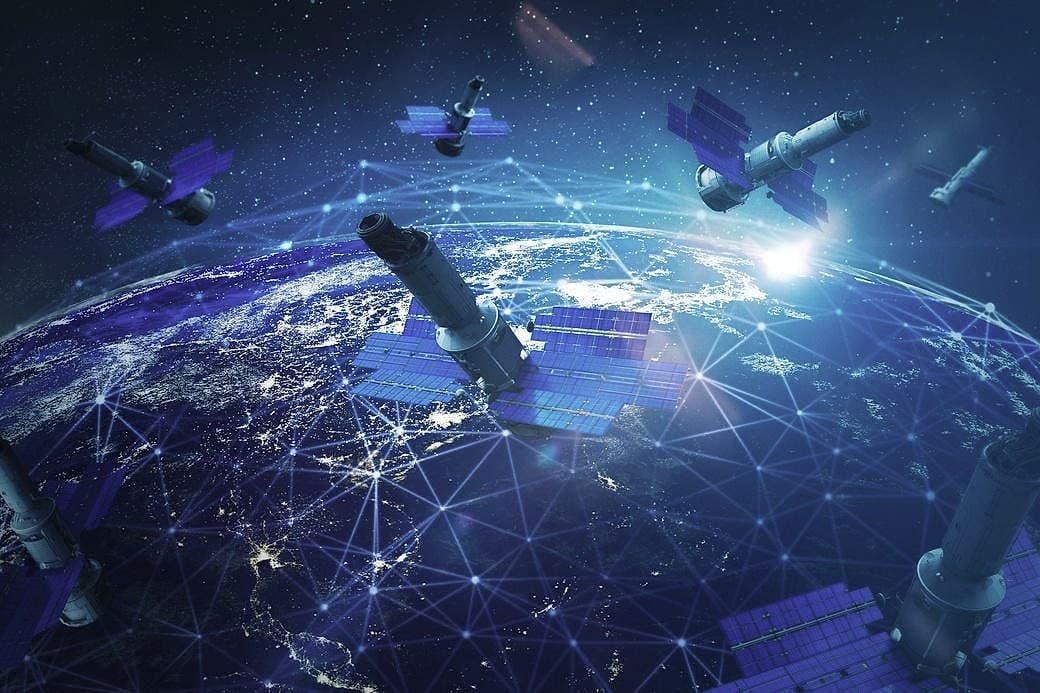
Integrated Cybersecurity for Space and Satellite Operations
Satellite services support communications, navigation, weather forecasting, Earth observation, emergency response, financial systems, transportation, and national security. Dawon provides operational intelligence, threat detection, compliance and risk management, incident readiness and response across the complete space system architecture, from spacecraft and communication links to mission control, ground stations, and user services.
- Space
- Link
- Ground
- User
Space Operations Form an Interdependent Security Architecture
A satellite does not operate independently. Mission success depends on spacecraft hardware and software, telemetry and command links, ground stations, mission control systems, cloud infrastructure, data processing platforms, user terminals, and specialized suppliers.
A compromise within any segment can affect mission availability, command integrity, payload data, service delivery, or the critical infrastructure that relies on space based capabilities.
Limited Physical Access
Once a spacecraft is in orbit, direct maintenance or component replacement may be impossible. Cybersecurity controls must account for limited processing capacity, restricted bandwidth, intermittent connectivity, and the operational risks associated with remote changes.
Command and Control Integrity
Telemetry, Tracking and Command systems perform high consequence functions. Unauthorized commands, compromised credentials, altered mission plans, or manipulation of command infrastructure can affect spacecraft configuration, payload operations, or orbital safety.
Communication Link Exposure
Uplinks, downlinks, crosslinks, and user service connections may be exposed to jamming, spoofing, interception, replay, or unauthorized transmission. Link security must preserve the authenticity and confidentiality of mission communications.
Long Mission Lifecycles
Satellites may remain operational for many years while cyber threats, software dependencies, and cryptographic requirements continue to evolve. Some missions must manage inherited components that cannot be easily updated after launch.
Ground Segment Dependencies
Ground stations and mission control environments may integrate enterprise IT, operational technology, cloud services, remote access systems, engineering tools, and third party networks. These terrestrial systems can provide pathways to mission critical functions.
Complex Supply Chains
Space missions depend on specialized hardware, embedded software, commercial components, open source libraries, launch services, communication providers, and mission partners. A weakness introduced during development or integration may remain throughout the mission lifecycle.
Distinguishing Cyber Events from Operational Anomalies
Space weather, radiation effects, hardware degradation, communication loss, and software faults may produce behaviour similar to malicious activity. Effective investigation requires correlation between cybersecurity, telemetry, operational, and environmental intelligence.
Security Intelligence Across the Mission Architecture
Dawon establishes a shared security context across space, link, ground, and user segments, enabling technical findings to be evaluated against mission objectives and service dependencies.
Space System Asset Intelligence
Develop contextual intelligence across spacecraft buses, payloads, onboard computers, flight software, communication equipment, ground stations, mission control systems, user terminals, and supporting infrastructure.
Dependency Mapping
Connect spacecraft and ground system components to the services they support. Understand how the disruption of a command server, antenna system, payload processor, communication provider, or software component could affect mission availability and downstream users.
Telemetry and Command Assurance
Monitor security relevant activity associated with mission planning, telemetry processing, command generation, authentication, and command transmission. Identify unexpected access, unauthorized changes, anomalous commands, and deviations from approved operational procedures.
Ground Segment Threat Detection
Detect abnormal communications, unauthorized devices, suspicious remote access, configuration changes, credential misuse, and unexpected data movement across ground stations and mission control environments.
Spacecraft Behaviour Intelligence
Correlate telemetry, operational status, software events, and threat intelligence to support the investigation of unusual spacecraft or payload behaviour. This helps teams distinguish potential cyber activity from technical faults and environmental conditions.
Software and Configuration Assurance
Maintain intelligence across flight software, firmware, ground applications, cryptographic components, configuration baselines, software libraries, and update histories. Identify affected mission components when vulnerabilities or supplier risks emerge.
Supply Chain and Partner Governance
Assess dependencies involving manufacturers, integrators, launch providers, ground station operators, cloud providers, communication partners, and software suppliers. Track responsibilities and supporting evidence throughout the mission lifecycle.
Mission Aware Incident Response
Develop response procedures for unauthorized commands, compromised ground systems, communication interference, credential exposure, payload disruption, malicious software changes, and supply chain incidents.
A Unified Model for Every Mission Segment
Space Segment
Spacecraft buses, payloads, onboard computers, flight software, attitude and orbit control systems, power management, communication equipment, and inter satellite links.
Link Segment
Telemetry, tracking, command, payload data, crosslink, feeder link, and user service communications connecting spacecraft to ground and other space systems.
Ground Segment
Ground stations, antenna systems, mission control centres, flight dynamics systems, command platforms, engineering workstations, data processing environments, and supporting operational infrastructure.
User Segment
User terminals, service gateways, receivers, customer platforms, applications, APIs, and critical infrastructure systems consuming satellite enabled services.
Four Segments, One Security Intelligence Layer
Space Segment
SPACECRAFT BUS · PAYLOAD · FLIGHT SOFTWARE · ONBOARD COMMUNICATIONS
A crosslink stays inside the space segment, spacecraft to spacecraft.
Link Segment
TT&C · PAYLOAD DATA · CROSSLINKS · USER LINKS
Ground Segment
GROUND STATIONS · MISSION CONTROL · DATA PROCESSING · CLOUD & ENGINEERING SYSTEMS
A user link reaches the user segment directly, without passing through the ground segment.
User Segment
TERMINALS · SERVICE PLATFORMS · APPLICATIONS · CRITICAL INFRASTRUCTURE
ASSET INTELLIGENCE · ACTIVE PROTECTION · THREAT DETECTION · RISK MANAGEMENT · INCIDENT RESPONSE · COMPLIANCE
- Segment coupling, both directions
- A crosslink stays inside the space segment, spacecraft to spacecraft.A user link reaches the user segment directly, without passing through the ground segment.
- Covered by the intelligence layer
Not every link lands on the ground. A crosslink never leaves the space segment and a user service link reaches a terminal directly, so an event in one segment does not have to travel through the next to reach the service.
Applications Across the Space Ecosystem
One Ecosystem, From Orbit to the Ground
Geostationary Orbit
GEO · 35,786 KMCOMMUNICATIONS · WEATHER
Medium Earth Orbit
MEO · 2,000 TO 35,786 KMNAVIGATION AND TIMING · COMMUNICATIONS
Low Earth Orbit
LEO · 160 TO 2,000 KMEARTH OBSERVATION · CONSTELLATIONS
Ground and User Segments
GROUND STATIONS · MISSION CONTROL · SERVICE PLATFORMS · TERMINALS
- Communications
- Transportation
- Energy
- Weather
- Emergency Services
- National Infrastructure
- Downlink to the ground segment
- Orbital regime, not drawn to scale
Each regime is chosen for what the mission needs from it, and the services on the ground inherit whatever happens to the segments above them.
Satellite Communications
Protect the systems supporting broadband, broadcast, emergency communications, enterprise connectivity, and communication services delivered through geostationary, medium Earth orbit, and low Earth orbit satellites.
Earth Observation and Remote Sensing
Secure payload operations, tasking commands, image acquisition, ground processing, data distribution, and customer access platforms supporting environmental monitoring, agriculture, mapping, infrastructure assessment, and disaster response.
Positioning, Navigation, and Timing
Support the resilience of systems delivering or consuming satellite based positioning, navigation, and timing services used by transportation, energy, telecommunications, finance, and other critical sectors.
Weather and Scientific Missions
Protect scientific payloads, environmental sensors, mission planning platforms, ground processing systems, research networks, and data distribution services.
Satellite Constellations
Establish consistent intelligence and governance across large fleets of satellites, distributed ground stations, inter satellite links, shared software versions, and automated mission management systems.
Launch and Spaceport Operations
Secure launch support networks, payload processing facilities, telemetry systems, mission integration environments, ground support equipment, and coordination systems used during launch and early orbit operations.
Hosted Payloads and Shared Infrastructure
Assess security boundaries and responsibilities where multiple organizations share spacecraft platforms, payload services, ground stations, cloud infrastructure, or communication providers.
Operational and Regulatory Outcomes
Unified security intelligence across space, link, ground, and user segments
Improved protection of telemetry, command, payload, and mission data
Earlier identification of abnormal mission and ground system activity
Risk prioritization based on mission and service consequences
Stronger control over software, configurations, credentials, and cryptographic dependencies
Improved governance of suppliers, integrators, and mission partners
Coordinated response to incidents affecting spacecraft and terrestrial systems
Greater resilience for critical services dependent on satellite capabilities
Traceable security evidence across the mission lifecycle
 NIST IR 8270
- NIST IR 8401
- NIST Cybersecurity Framework 2.0
 NASA Space Security: Best Practices Guide
- Space Policy Directive 5
 CISA Recommendations to Space System Operators for Improving Cybersecurity
- CCSDS 355.0 B 2
 ECSS E ST 80C
 NIS2 and applicable national space sector requirements
Strengthen Security Across the Complete Space Mission
Discuss how Dawon can support security intelligence, mission assurance, and incident readiness across spacecraft, communication links, ground infrastructure, and satellite enabled services.
Expert Support for X-IOT Security Incidents
Take advantage of comprehensive incident readiness and response services. Our team provides end-to-end incident response, digital forensics, and legal support.